Architecture
100% serverless on AWS. Entire infrastructure as code in a single SAM template.
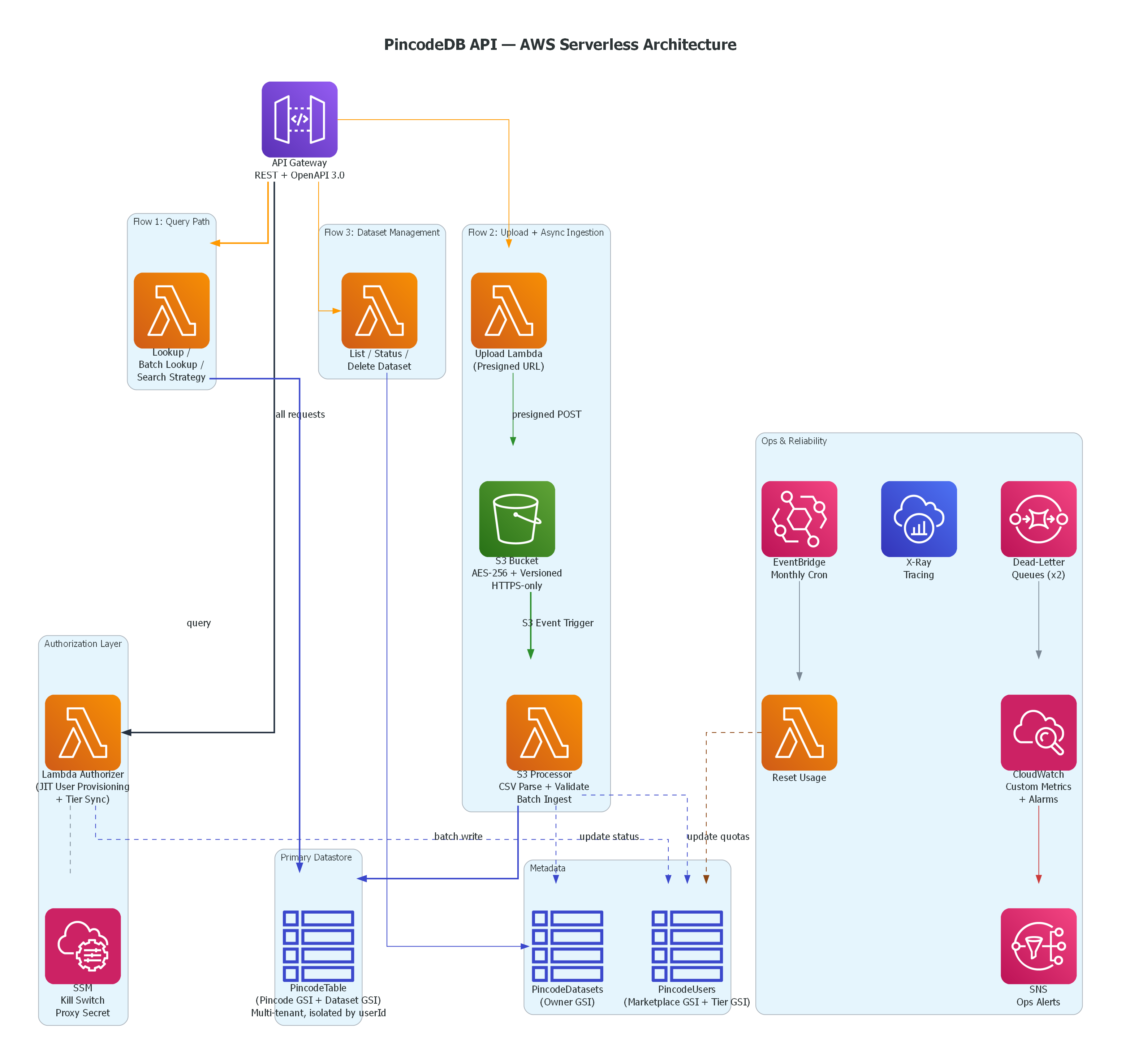
A serverless, multi-tenant backend that turns any CSV of postal codes into a private, queryable REST API. Upload the CSV. Get a live API back in seconds. No server provisioning, no database setup, nobody else's data mixed with yours.
POST /postal-code/uploaddatasetId.
The CSV never passes through API Gateway — no 10MB limit.
ObjectCreated event. The processor Lambda
parses the CSV, validates the schema, and batch-writes to DynamoDB.
Quota counters update atomically.
GET /dataset/{id}/status → SUCCEEDED.
Then GET /postal-code/search?pincode=110001
— your private data comes back instantly.
Companies — especially logistics, e-commerce, and fintech — maintain their own
pincode master data in spreadsheets. These aren't raw post office records; they
carry business-specific columns like delivery_sla,
risk_score, is_serviceable, zone_type.
When a backend team needs this data as an API, the realistic options are: build and host your own lookup service, or use a public pincode API that knows nothing about your internal columns.
PincodeDB is option 3: upload the CSV, get a live queryable API in seconds. Private, isolated, yours.
internalUserId.
Three GSIs cover three access patterns. Cross-tenant isolation is enforced
structurally at the query — not by application-level filtering that could be bypassed.
One table, all users, zero leakage.
/pincode-api/enabled.
Set it to false and the authorizer denies every request globally,
instantly — no deployment, no code change. The authorizer reads this on every
request before any user-facing work happens.
customData map in DynamoDB and returned as-is.
A logistics company uploads pincode,sla,risk,is_serviceable with
no schema pre-registration required.
LatencyMs, RequestsOk,
RowsIngested, RequestedPins via aws-embedded-metrics.
X-Ray distributed tracing on all functions. SQS DLQ depth alarm wired to SNS
for ops alerting.
def handler(event, context):
    # Every request: validate → lookup → provision/sync
    _validate_proxy_secret(event['authorizationToken'])

    marketplace_id = _extract_marketplace_id(event)
    current_tier   = _get_tier_from_headers(event)

    user = users_table.get_item(
        Key={'marketplaceId': marketplace_id}
    ).get('Item')

    if not user:
        # First request — create user on the spot
        user = _provision_user(marketplace_id, current_tier)
    elif user['tier'] != current_tier:
        # Subscription changed — sync immediately
        user = _sync_tier(user, new_tier=current_tier)

    # Downstream Lambdas receive userId + tier in context
    return _build_allow_policy(
        principal=user['internalUserId'],
        context={
            'userId': user['internalUserId'],
            'tier':   user['tier'],
        }
)def is_api_enabled(ssm) -> bool:
"""
One SSM parameter. Instant global shutoff.
No deployment. No code change.
"""
param = ssm.get_parameter(
Name='/pincode-api/enabled'
)
return param['Parameter']['Value'] == 'true'
def query_pincodes(table, user_id: str,
pincode: str) -> list:
"""
Single-table multi-tenancy.
All tenants share one table — partition key
is internalUserId. Cross-tenant leakage is
impossible at the DynamoDB query level.
"""
return table.query(
KeyConditionExpression=(
Key('internalUserId').eq(user_id) &
Key('pincode_officename').begins_with(
pincode
)
)
)['Items']| Function | What it does |
|---|---|
| Authorizer | JIT user provisioning + tier sync on every request. Validates RapidAPI proxy secret. |
| Lookup | Single pincode search — queries user's own datasets with optional public fallback. |
| Batch Lookup | Up to 100 pincodes in one call. Same isolation guarantees as single lookup. |
| Search Strategy | Custom priority chain: specific dataset → all private → public. Growth+ only. |
| Upload | Generates presigned S3 POST URL with tier-based size limits enforced by policy. |
| S3 Processor | Parses CSV, validates schema, batch-writes to DynamoDB, updates quotas + status. |
| List Datasets | Returns all datasets owned by the authenticated user. |
| Get Status | Returns processing status for a specific dataset: PROCESSING / SUCCEEDED / FAILED. |
| Delete Dataset | Deletes records, metadata, and adjusts quota counters. BUSINESS+ only. |
| Reset Usage | Scheduled monthly via EventBridge — resets paid tier usage counters. |
| Method | Path | Auth | Description |
|---|---|---|---|
| GET | /health | Public | Health check |
| GET | /postal-code/search | Required | Lookup a single pincode — all datasets or a specific one, with optional public fallback |
| POST | /postal-code/batch-search | Required | Batch lookup up to 100 pincodes in one call |
| POST | /postal-code/search-strategy | GROWTH+ | Chained search with custom priority order: specific dataset → all private → public |
| POST | /postal-code/upload | Required | Get a presigned S3 POST URL to upload a CSV dataset |
| GET | /datasets | Required | List all uploaded datasets for the authenticated user |
| GET | /dataset/{datasetId}/status | Required | Check processing status of a dataset |
| DELETE | /dataset/{datasetId} | BUSINESS+ | Delete a private dataset and all its records |
| Tier | Max File | Max Rows | Max Datasets | Dynamic Schema |
|---|---|---|---|---|
| FREE | 50 KB | 250 | 1 | No |
| BUSINESS | 10 MB | 1,000,000 | 50 | No |
| GROWTH | 20 MB | 5,000,000 | 200 | Yes |
| ENTERPRISE | 50 MB | 25,000,000 | 1,000 | Yes |
internalUserId. Ownership checks on delete and status operations. No way to reach another tenant's data.DeleteObject denied on raw uploads via IAM./pincode-api/enabled. Set to false → instant global shutoff. No deployment, no code change.ruff — fast Python linter, runs on every push.black — enforced code style, fails CI on diff.pytest with moto — ~40 tests, no real AWS calls.sam validate — template validation against CloudFormation schema.moto to mock AWS services (DynamoDB, S3, SSM) in-process.
Covers happy paths, auth failures, quota enforcement, encoding edge cases,
S3 duplicate event handling, and pagination.
template.yaml. sam deploy --guided creates everything.
DeletionPolicy: Retain
in the SAM template. Deleting the CloudFormation stack does not delete
production data.